
Introduction
In this guide, we’ll break down how to read and write chess notation, including:
✔️ Chessboard coordinates and piece symbols
✔️ How to record moves correctly
✔️ Special moves like castling and pawn promotion
✔️ How to read captures, checks, and checkmates
Chess notation is the language of chess. If you want to improve your game, analyze grandmaster games, or discuss strategies with other players, understanding algebraic notation is essential.
By the end of this guide, you’ll be able to understand chess notation like a pro and use it to enhance your skills.
1. Understanding Chessboard Coordinates (Algebraic Notation Basics)
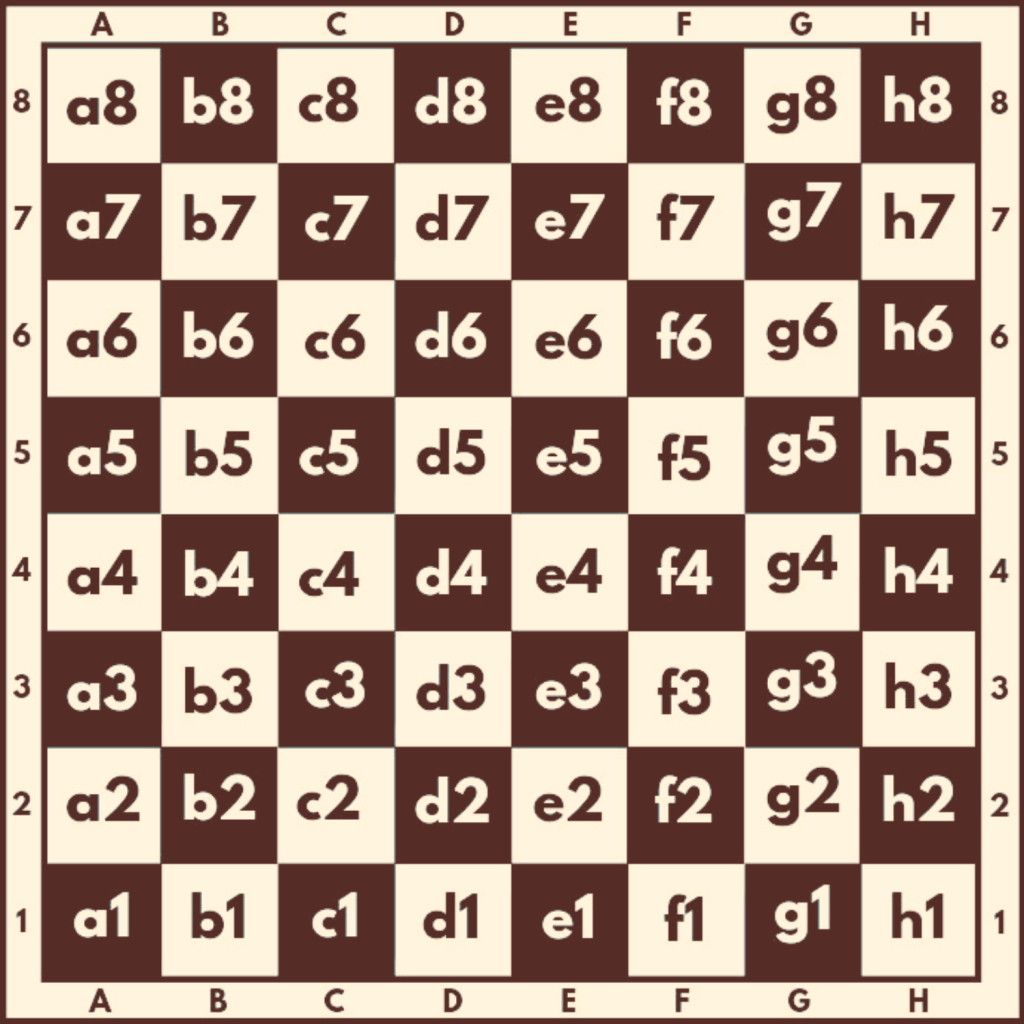
Chess notation uses a coordinate system to identify each square on the board. The chessboard consists of 64 squares arranged in an 8×8 grid. Every move in chess is recorded using algebraic notation, which consists of:
- Files (Columns): Marked from a to h (left to right from White’s perspective).
- Ranks (Rows): Marked from 1 to 8 (bottom to top from White’s perspective).
Example Squares
📌 e4 → The square in file e, rank 4.
📌 g7 → The square in file g, rank 7.
🎯 Key takeaway: Every square on the board has a unique coordinate based on its file and rank.
📌 Visualizing the Board:
a b c d e f g h
8 ♜ ♞ ♝ ♛ ♚ ♝ ♞ ♜ 8
7 ♟ ♟ ♟ ♟ ♟ ♟ ♟ ♟ 7
6 . . . . . . . . . . . 6
5 . . . . . . . . . . .
4 . . . . . . . . . . .
3 . . . . . . . . . . .
2 ♙ ♙ ♙ ♙ ♙ ♙ ♙ ♙ 2
1 ♖ ♘ ♗ ♕ ♔ ♗ ♘ ♖ 1
a b c d e f g h
2. How to Write and Read Chess Moves
In algebraic notation, each move is recorded using the piece symbol and the destination square.
📌 Piece Symbols:
- K = King
- Q = Queen
- R = Rook
- B = Bishop
- N = Knight (since “K” is used for the king)
- Pawns do not have a letter (only their destination square is recorded).

Examples of Basic Moves
✔️ Pawn Move: e4 (A pawn moves to e4)
✔️ Knight Move: Nf3 (A knight moves to f3)
✔️ Bishop Move: Bb5 (A bishop moves to b5)
🎯 Key takeaway:
- If no piece letter is written, it’s a pawn move.
- Other pieces use their symbol followed by the square they move to.
3. Capturing Pieces in Chess Notation
When a piece captures another piece, an “x” is added before the destination square.
Examples of Captures
✔️ Pawn Captures: exd5 (Pawn on e4 captures a piece on d5).
✔️ Knight Captures: Nxe5 (Knight captures a piece on e5).
✔️ Queen Captures: Qxd4 (Queen captures a piece on d4).
🎯 Key takeaway:
- Capturing notation uses x to indicate a capture.
- The capturing piece symbol is still included (except for pawns).
4. How to Write Special Moves in Chess Notation
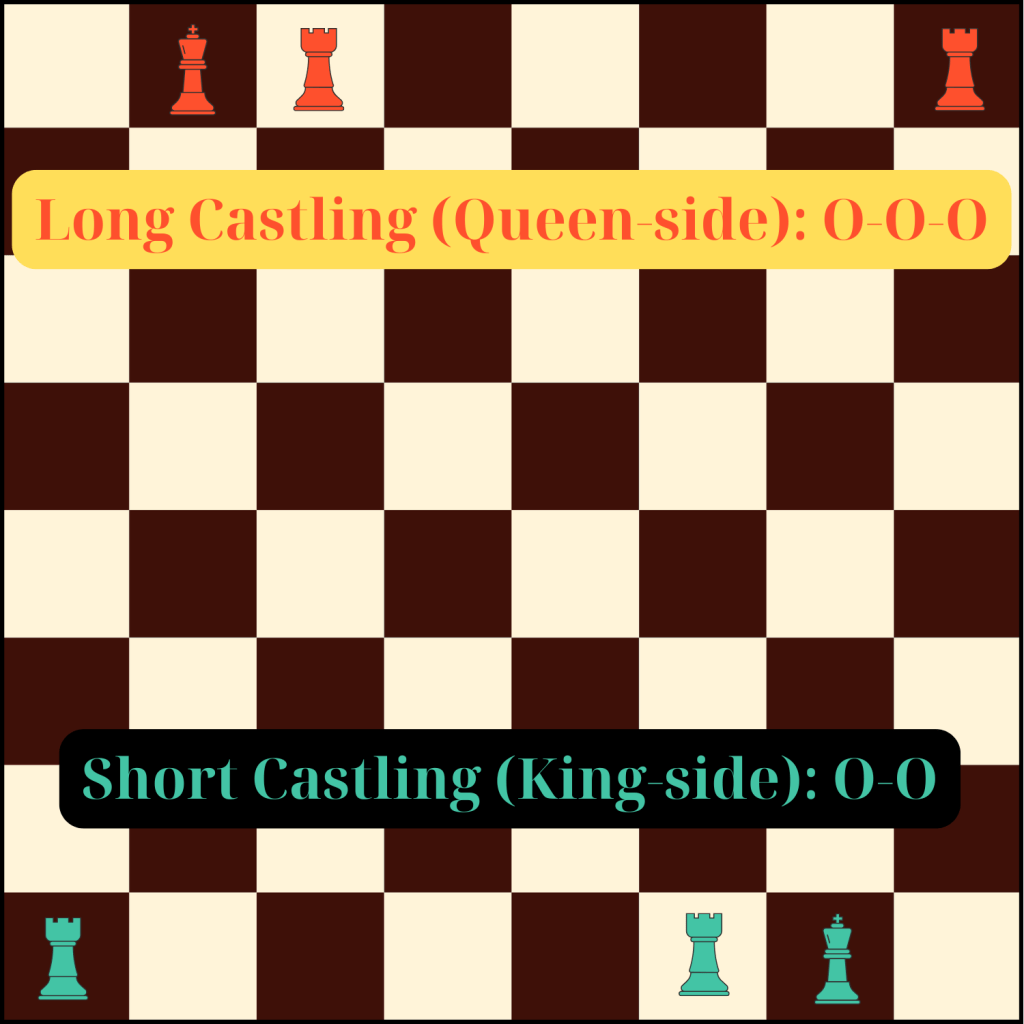
Castling (King Safety Move)
- Short Castling (King-side):
O-O(The king castles to the right). - Long Castling (Queen-side):
O-O-O(The king castles to the left).
Pawn Promotion (When a Pawn Reaches the Last Rank)
When a pawn reaches the 8th rank, it must be promoted (usually to a queen).
- Example:
e8=Q(Pawn moves to e8 and promotes to a queen).
En Passant (Special Pawn Capture Rule)
If a pawn moves two squares forward, an opponent’s adjacent pawn can capture it as if it moved only one square.
- Example:
exd6 e.p.(Pawn on e5 captures a pawn on d6 en passant).
🎯 Key takeaway: Special moves have unique notation but follow simple rules.
5. Notation for Check, Checkmate, and Draws
Check (+) and Checkmate (#)
Qh5+→ (Queen moves to h5 and checks the king).Qh5#→ (Queen moves to h5 and checkmates the king).
Stalemate and Draws
1/2-1/2→ (Game ends in a draw).½-½→ (Another way to write a draw).
🎯 Key takeaway:
- Check (+) and checkmate (#) should always be noted when they occur.
- Draws are recorded as 1/2-1/2 in tournament games.
6. When Two Pieces Can Move to the Same Square
If two identical pieces (like knights or rooks) can move to the same square, extra information is added to clarify which piece moves.
Examples:
✔️ Nbd2 (The knight from the b-file moves to d2).
✔️ R1d5 (The rook from rank 1 moves to d5).
🎯 Key takeaway: If two pieces of the same type can move to a square, specify either the file or the rank.
7. Why Learning Chess Notation Is Important
✅ Study Grandmaster Games: You can read and analyze classic games from players like Magnus Carlsen and Garry Kasparov.
✅ Improve Faster: Recording your games helps you find mistakes and improve strategy.
✅ Compete in Tournaments: Tournament chess requires notation for move tracking.
Example Game Notation (Famous Opening)

Here’s a short game notation using Ruy López Opening:
1. e4 e5
2. Nf3 Nc6
3. Bb5 Nge7
4. Nc3 Ng6
5. d4 exd4
💡 This shows a classic opening where both top players develop their pieces logically.
Final Thoughts: Master Chess Notation & Improve Your Game!
Understanding algebraic notation is essential for every serious chess player. It allows you to:
✔ Record and review your games
✔ Study famous games and strategies
✔ Improve your tactical awareness and opening knowledge
🚀 Want to take your chess skills to the next level?
- Start writing down your moves in every game.
- Analyze GM games to see how the best players think.
- Practice tactics daily to sharpen your calculation skills.
👉 What part of chess notation do you find most challenging? Let me know in the comments! 🎯♟️
 Just Golden Queen
Leave a comment